Smartphone Network Technologies Explained: 1G to upcoming 6G (2026 Guide)
Modern smartphones have become an essential part of everyday life. Whether you’re making voice calls, sending messages, browsing the internet, streaming videos, or using AI-powered applications, everything depends on a reliable mobile network.
Behind every successful phone call or internet connection is a complex wireless communication system consisting of radio signals, cellular towers, fiber-optic networks, and switching centers that work together almost instantly. Over the past four decades, mobile networks have evolved from simple analog voice communication to ultra-fast 5G connectivity capable of supporting smart cities, autonomous vehicles, cloud gaming, and billions of connected IoT devices.
This comprehensive guide explains how mobile networks work, explores popular wireless technologies such as GSM, CDMA, HSPA, LTE, VoLTE, and 5G, and also looks ahead at the future of 6G technology.
Table of Contents
Quick Summary
A mobile network allows smartphones and other wireless devices to communicate using radio waves and cellular towers. Each new generation—from 1G to 5G—has introduced significant improvements in speed,
capacity, security, and network reliability, with 6G expected to take wireless communication even further.
What Is a Smartphone Network?
A mobile network is a wireless communication system that enables smartphones, tablets, smartwatches, and other connected devices to communicate without requiring physical cables. Instead of wired connections, mobile networks use radio frequencies and a vast infrastructure of cellular towers to transmit voice, text messages, and internet data.
Whenever you make a phone call, send a WhatsApp message, browse a website, or stream a video, your device communicates with the nearest cellular tower. That information is then routed through multiple network components before reaching its final destination.
Today’s mobile networks are designed to provide:
- Voice calling
- SMS and MMS messaging
- Mobile internet access
- Video calling
- Online gaming
- Cloud services
- AI-powered applications
- Internet of Things (IoT) connectivity
Did You Know?
Modern smartphones automatically switch between different network technologies such as 5G, 4G LTE, and even 3G (where available) depending on signal strength and carrier support.
Smartphone Network Technologies
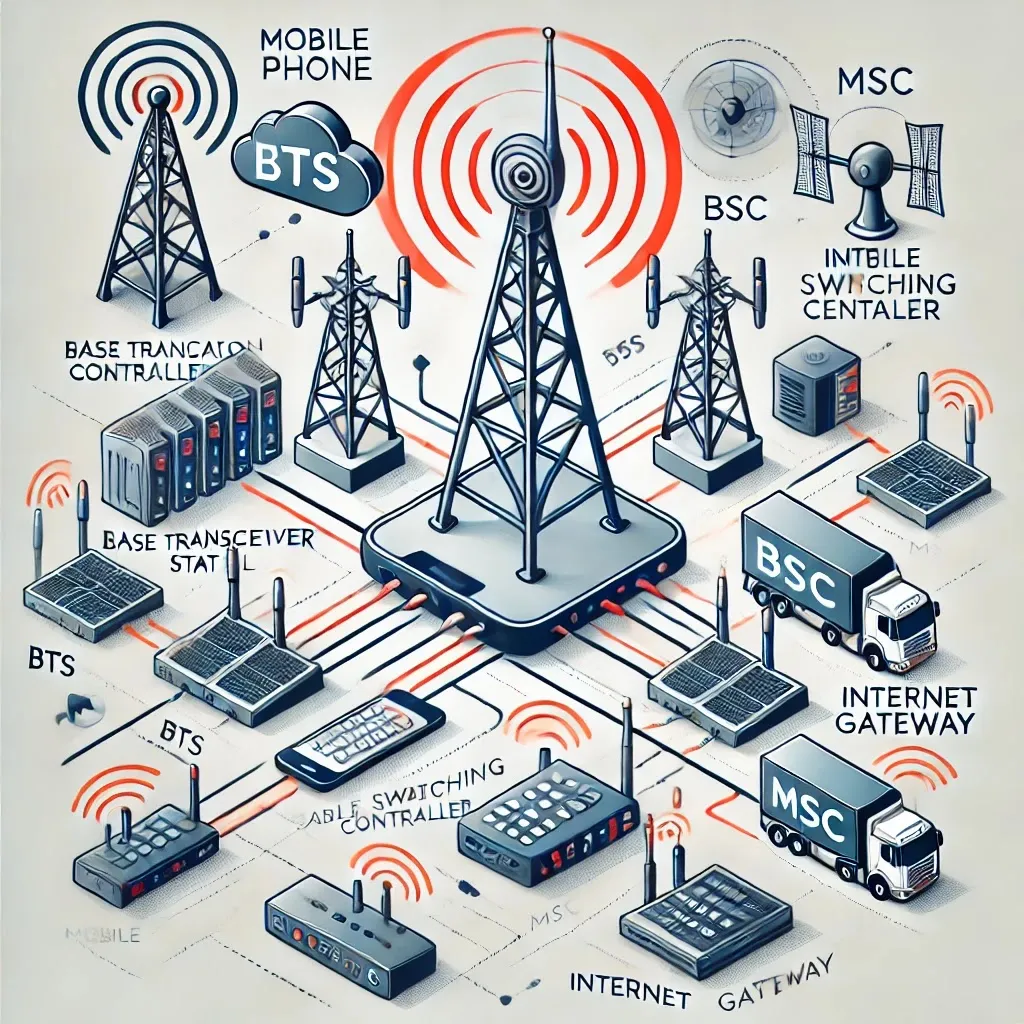
Over the years, several wireless communication technologies have been developed to improve call quality, network efficiency, internet speed, and overall user experience. Although newer standards have replaced older ones in many countries, understanding these technologies helps explain how modern mobile communication has evolved.
| Technology | Primary Purpose | Generation |
|---|---|---|
| GSM | Digital voice calls and SMS | 2G |
| CDMA | Alternative digital communication standard | 2G / 3G |
| HSPA | Faster mobile internet | 3G |
| HSPA+ | Enhanced 3G performance | 3.5G |
| LTE | High-speed mobile broadband | 4G |
| VoLTE | Voice calling over LTE networks | 4G |
| 5G NR | Ultra-fast wireless communication | 5G |
Each technology introduced improvements over its predecessor, making mobile communication faster, more reliable, and capable of supporting increasingly demanding applications.
How Does a Mobile Network Work?
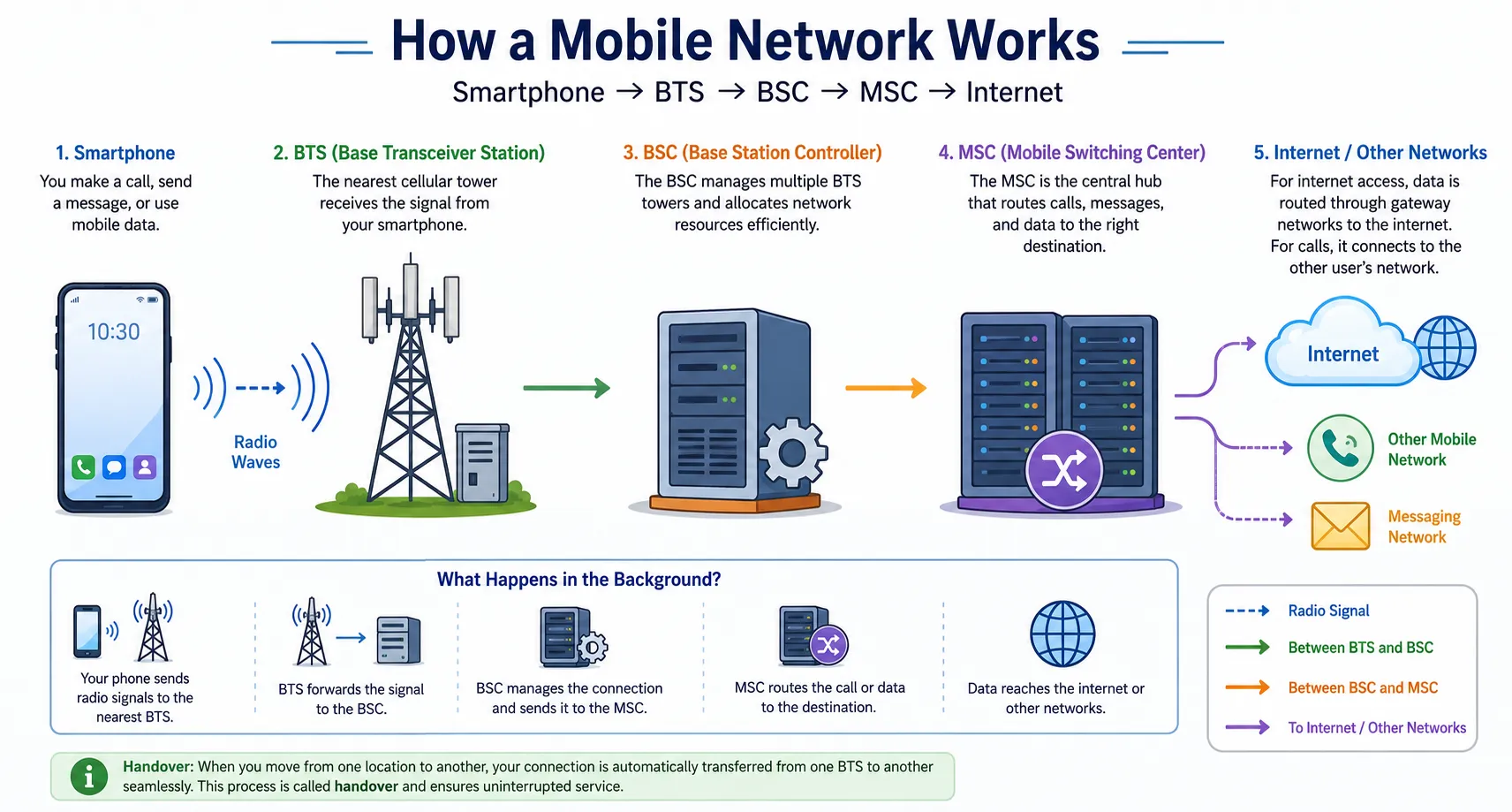
Although making a phone call or opening a website appears almost instantaneous, several network components work together behind the scenes to complete every request.
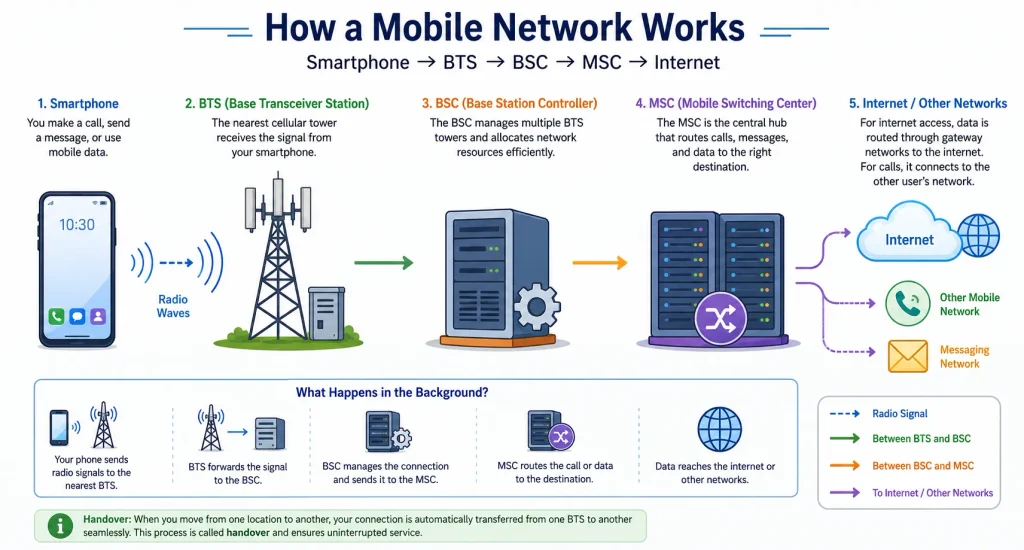
Step 1: Your Smartphone Sends a Signal
When you make a phone call, send a message, or access mobile data, your smartphone converts that information into radio signals. These signals are transmitted to the nearest cellular tower, commonly known as a Base Transceiver Station (BTS).
Step 2: Base Station Processing
The BTS forwards your request to the Base Station Controller (BSC), which manages multiple cellular towers. The BSC helps allocate network resources efficiently while ensuring users remain connected.
Step 3: Mobile Switching Center (MSC)
The BSC then transfers the request to the Mobile Switching Center (MSC), the central hub responsible for routing calls, messages, authentication, and subscriber management.
- If you’re calling another person, the MSC routes the call to the recipient’s nearest cellular tower.
- If you’re browsing the internet, the request is forwarded through the Packet Core Network before connecting to external internet servers.
Step 4: Internet Connectivity
When accessing websites or streaming content, your mobile operator’s core network connects your device to the global internet using high-speed fiber-optic cables, microwave links, and international gateways.
Step 5: Automatic Handover
As you travel, your smartphone continuously monitors nearby cellular towers. When another tower provides a stronger signal, the network automatically transfers your connection without interrupting your call or internet session.
What Is a Handover?
A handover is the process of automatically transferring an active mobile connection from one cellular tower to another while you are moving. This ensures uninterrupted voice calls and continuous internet connectivity during travel.
Modern mobile networks rely on multiple technologies—including fiber optics, microwave transmission, satellites, and cloud-based network management—to provide fast and reliable communication across cities, highways, rural regions, and even remote locations.
Types of Mobile Networks
Mobile communication has evolved through several generations over the past four decades. Each generation introduced major improvements in wireless technology, enabling faster speeds, better voice quality, stronger security, and support for increasingly advanced applications.
The evolution of mobile networks can be summarized as follows:
| Generation | Introduced | Main Improvement |
|---|---|---|
| 1G | 1980s | Analog voice communication |
| 2G | 1990s | Digital calls and SMS |
| 3G | Early 2000s | Mobile internet |
| 4G | 2010s | High-speed broadband |
| 5G | 2020s | Ultra-fast, low-latency communication |
| 6G | Expected by 2030 | AI-driven intelligent networking |
In the following sections, we’ll explore each generation in detail, starting with the earliest analog mobile networks and progressing to the latest advancements in wireless communication.
1G (First Generation Mobile Network)
The first generation of mobile communication, commonly known as 1G, was introduced during the early 1980s. It marked the beginning of wireless mobile communication by allowing users to make voice calls without being connected to traditional telephone lines.
Unlike modern mobile networks, 1G relied entirely on analog radio signals. While this was revolutionary at the time, the technology had several limitations, including poor call quality, limited network capacity, and almost no security.
Since 1G supported only voice communication, users could not send text messages, browse the internet, or transfer data.
Key Features of 1G
- Analog voice communication
- Basic wireless calling
- No internet connectivity
- No SMS support
- Limited network coverage
- Minimal security and encryption
Advantages of 1G
- Introduced mobile wireless communication.
- Allowed users to make calls without wired telephone connections.
- Laid the foundation for future mobile technologies.
Limitations of 1G
- Poor voice quality
- Frequent signal interference
- No digital encryption
- No data services
- Low network capacity
- Very limited roaming support
Did You Know?
Most countries completely retired 1G networks decades ago. Today, they exist only as an important milestone in the history of wireless communication.
2G (Second Generation): GSM & CDMA
The introduction of 2G during the early 1990s marked one of the biggest milestones in mobile communication. It replaced analog technology with digital communication, dramatically improving voice quality, network security, and spectrum efficiency.
For the first time, users could send text messages, enjoy clearer voice calls, and benefit from stronger encryption. Basic mobile internet also became possible through technologies such as GPRS and EDGE, although speeds were modest compared to modern standards.
Two major communication standards dominated the 2G era:
- GSM (Global System for Mobile Communications)
- CDMA (Code Division Multiple Access)
What is GSM?
GSM became the world’s most widely adopted mobile communication standard. It introduced the use of SIM (Subscriber Identity Module) cards, making it easy for users to switch devices while keeping the same mobile number.
Because GSM was adopted by most countries, it quickly became the global standard for mobile communication and international roaming.
Main Features of GSM
- Digital voice communication
- SIM card support
- SMS messaging
- Improved security using encryption
- Better call quality than 1G
- International roaming support
- Basic mobile internet through GPRS and EDGE
Advantages of GSM
- Widely supported worldwide
- Easy SIM card replacement
- Better battery efficiency
- Reliable international compatibility
- Strong ecosystem of compatible devices
Limitations of GSM
- Relatively slow internet speeds
- Network congestion in crowded areas
- Limited multimedia capabilities
Typical 2G Speed
Standard GSM networks typically delivered speeds of around 50 Kbps, which was sufficient for text-based web pages and basic email but far too slow for today’s internet applications.
What is CDMA?
CDMA, or Code Division Multiple Access, was another major wireless communication technology used alongside GSM in several countries. Instead of assigning each call to a separate frequency or time slot, CDMA allowed multiple users to share the same frequency spectrum simultaneously using unique digital codes.
This approach improved network efficiency and call quality while increasing overall capacity.
Main Features of CDMA
- Digital voice communication
- Higher spectrum efficiency
- Better call quality
- Improved security
- Higher user capacity
- Reduced dropped calls
Advantages of CDMA
- Better voice clarity
- Improved network capacity
- Strong signal reliability
- Good performance in densely populated areas
Limitations of CDMA
- Limited international adoption
- Device compatibility restrictions
- Less flexible than GSM for switching devices
GSM vs CDMA
While GSM became the dominant global standard because of its SIM-based architecture and widespread carrier support, CDMA gained popularity in specific regions due to its efficient use of radio spectrum and strong call quality.
3G (Third Generation Mobile Network)
The launch of 3G during the early 2000s transformed mobile phones from simple communication devices into portable internet-enabled computers. For the first time, users could browse modern websites, stream music, download applications, and make video calls using mobile networks.
Compared to 2G, 3G offered significantly higher bandwidth, making internet access practical for everyday use.
Main Features of 3G
- Mobile internet access
- Video calling
- Faster downloads
- Email synchronization
- App downloads
- Improved multimedia support
Advantages of 3G
- Much faster internet than 2G
- Better support for smartphones
- Smoother browsing experience
- Improved voice quality
- Support for multimedia applications
Limitations of 3G
- Higher battery consumption
- Limited speed compared to 4G
- Network congestion under heavy loads
Typical 3G Speed
Most 3G networks delivered speeds of up to 2 Mbps, representing a massive improvement over 2G’s approximately 50 Kbps.
HSPA (High-Speed Packet Access)
As smartphones became more popular, users demanded faster internet speeds for streaming videos, downloading apps, and browsing richer websites. To meet this demand, network operators introduced HSPA (High-Speed Packet Access), an enhanced version of 3G technology.
HSPA significantly improved download and upload performance without requiring a completely new network infrastructure.
Main Features of HSPA
- Higher download speeds
- Improved upload performance
- Better video streaming
- Lower latency than standard 3G
- Enhanced browsing experience
Typical Applications
- YouTube streaming
- Music streaming
- App downloads
- Social media
- Email attachments
HSPA+ (Evolved High-Speed Packet Access)
HSPA+, often referred to as 3.5G, was the final major evolution of 3G technology before the arrival of LTE. It introduced substantial improvements in speed, latency, and network efficiency.
Depending on network configuration, HSPA+ could theoretically achieve download speeds of up to 42 Mbps, making it suitable for HD video streaming and faster application downloads.
Main Features of HSPA+
- Faster downloads than HSPA
- Improved upload speeds
- Reduced latency
- Better network efficiency
- Smoother HD video streaming
Why HSPA+ Was Important
HSPA+ acted as a bridge between traditional 3G networks and the much faster 4G LTE era. Many operators upgraded existing 3G infrastructure to HSPA+ before investing in full LTE deployments.
4G (Fourth Generation): LTE & VoLTE
The introduction of 4G (Fourth Generation) revolutionized mobile communication by transforming smartphones into powerful internet-connected devices. While 3G made mobile internet practical, 4G significantly improved download speeds, reduced latency, and enabled high-quality video streaming, online gaming, and cloud-based applications.
The core technology behind 4G is LTE (Long-Term Evolution), which provides much faster and more efficient wireless communication than previous generations. Unlike 2G and early 3G networks, LTE was designed primarily for high-speed packet data, making it ideal for modern internet usage.
Key Features of 4G LTE
- High-speed mobile broadband
- HD and 4K video streaming
- Fast downloads and uploads
- Low network latency
- Improved network capacity
- Support for cloud applications
- Better battery efficiency than older technologies
Typical 4G Applications
- Netflix, YouTube, and Disney+ streaming
- Video conferencing
- Cloud storage and file synchronization
- Online multiplayer gaming
- Social media platforms
- Remote learning and work-from-home applications
Typical LTE Speeds
Under ideal conditions, LTE networks can theoretically deliver download speeds ranging from 100 Mbps to 1 Gbps, depending on network configuration, spectrum availability, and carrier aggregation.
What is LTE (Long-Term Evolution)?
LTE stands for Long-Term Evolution, a wireless communication standard developed to provide significantly faster mobile internet compared to traditional 3G technologies.
Although LTE is commonly associated with 4G, early LTE deployments technically did not meet the original ITU requirements for true 4G speeds. Later enhancements such as LTE-Advanced fully satisfied those requirements and became recognized as full 4G technology.
Advantages of LTE
- High-speed internet access
- Lower latency
- Better network efficiency
- Improved multimedia performance
- Reliable connectivity for modern smartphones
Limitations of LTE
- Coverage may vary by region.
- Speed depends on network congestion.
- Older LTE networks may not support advanced carrier aggregation features.
What is VoLTE (Voice over LTE)?
While LTE greatly improved internet performance, voice calls on early LTE networks were often routed through older 2G or 3G infrastructure. To overcome this limitation, mobile operators introduced VoLTE (Voice over LTE), allowing voice calls to be transmitted entirely over the 4G LTE network.
VoLTE provides faster call setup, clearer audio quality, and the ability to continue using high-speed mobile data while on a voice call.
Benefits of VoLTE
- HD voice quality
- Faster call connection times
- Simultaneous voice and 4G data usage
- Reduced call drops
- Improved battery efficiency
Good to Know
Most modern smartphones enable VoLTE automatically when supported by both the carrier and the device. Users generally do not need to configure it manually.
5G (Fifth Generation Mobile Network)
The rollout of 5G began globally around 2020 and represents one of the most significant advances in wireless communication. Designed for much higher speeds, lower latency, and greater network capacity, 5G supports not only smartphones but also connected vehicles, industrial automation, healthcare, smart cities, and billions of IoT devices.
Unlike previous generations that focused mainly on mobile phones, 5G was built to connect virtually everything.
Key Features of 5G
- Download speeds up to 10 Gbps
- Ultra-low latency (approximately 1–20 milliseconds)
- Massive device connectivity
- Higher spectrum efficiency
- Improved energy efficiency
- Support for AI-powered applications
- Enhanced reliability
Real-World Applications of 5G
- Cloud gaming
- Augmented Reality (AR)
- Virtual Reality (VR)
- Smart cities
- Remote healthcare
- Industrial automation
- Self-driving vehicles
- Smart agriculture
- AI-powered services
What is Massive MIMO?
One of the key technologies powering modern 5G networks is Massive MIMO (Multiple Input Multiple Output). This technology allows base stations to use dozens—or even hundreds—of antennas simultaneously to transmit and receive data.
Instead of serving one user at a time, Massive MIMO enables the network to communicate with multiple devices simultaneously, greatly improving capacity and reducing congestion in crowded areas.
Advantages of Massive MIMO
- Higher network capacity
- Improved signal quality
- Better spectrum utilization
- Faster data speeds
- Reduced network congestion
- Enhanced coverage
Example
Imagine a busy stadium with thousands of people using their phones at the same time. Massive MIMO helps distribute network resources efficiently, allowing more users to enjoy stable connections and faster internet speeds.
6G (Sixth Generation Mobile Network)
Although 5G deployment is still expanding worldwide, researchers and governments are already developing the next generation of wireless communication known as 6G.
Expected to launch commercially around 2030, 6G aims to provide dramatically higher speeds, AI-driven network optimization, intelligent communication systems, and near-instant connectivity.
While official specifications are still under development, researchers believe 6G could fundamentally transform how people interact with digital services.
Expected Features of 6G
- Internet speeds up to 100 Gbps
- AI-native network management
- Ultra-low latency
- Advanced holographic communication
- Improved energy efficiency
- Global satellite integration
- Better rural connectivity
- Support for future AI applications
6G Development in India
India is actively preparing for the future deployment of 6G technology through the Bharat 6G Vision, a national initiative focused on research, innovation, and indigenous technology development.
The long-term objective is not only to deploy 6G networks domestically but also to position India as a global contributor to international 6G standards, patents, and next-generation wireless technologies.
Expected Timeline
| Stage | Expected Timeline |
|---|---|
| Research & Development | Currently Ongoing |
| Pilot Testing | 2026–2028 |
| Commercial Rollout | Around 2030 |
Bharat 6G Mission Focus Areas
- Research and innovation
- Development of indigenous technologies
- Academic collaboration
- Startup ecosystem support
- International partnerships
- Global patent contributions
Indian Companies and Institutes Working on 6G
Several Indian organizations are already investing in next-generation wireless research and participating in the development of future communication technologies.
| Organization | Contribution |
|---|---|
| Reliance Jio | Research on future wireless infrastructure |
| Bharti Airtel | Advanced telecommunications research |
| IIT Hyderabad | 6G research and academic innovation |
| Department of Telecommunications (DoT) | Policy development and national coordination |
| Telecom Standards Development Society, India (TSDSI) | Contribution to global telecom standards |
Looking Ahead
While 6G is still several years away, ongoing research suggests it could enable technologies such as immersive holographic communication, AI-driven autonomous systems, digital twins, and seamless integration between terrestrial and satellite networks.
Mobile Network Generations Comparison
Each generation of mobile networks introduced major improvements in communication technology. The table below summarizes how mobile networks have evolved from simple analog voice calls to intelligent AI-powered wireless communication.
| Generation | Launch Period | Typical Speed | Main Innovation | Common Uses |
|---|---|---|---|---|
| 1G | 1980s | Analog Voice | Wireless Voice Calls | Voice Communication |
| 2G (GSM/CDMA) | 1990s | Up to 50 Kbps | Digital Voice & SMS | Calling, Messaging |
| 3G | Early 2000s | Up to 2 Mbps | Mobile Internet | Web Browsing, Video Calls |
| HSPA / HSPA+ | Mid-2000s | Up to 42 Mbps | Enhanced 3G | Streaming, Downloads |
| 4G LTE | 2010s | 100 Mbps – 1 Gbps | High-Speed Broadband | HD Streaming, Gaming |
| 5G | 2020s | Up to 10 Gbps | Ultra-Low Latency | IoT, AI, Smart Cities, Cloud Gaming |
| 6G (Expected) | Around 2030 | Up to 100 Gbps | AI-Native Intelligent Networks | Holographic Communication, Autonomous Systems |
Evolution of Mobile Networks
| Generation | Voice | SMS | Internet | Video Calling | HD Streaming | AI & IoT |
|---|---|---|---|---|---|---|
| 1G | ✅ | ❌ | ❌ | ❌ | ❌ | ❌ |
| 2G | ✅ | ✅ | Basic | ❌ | ❌ | ❌ |
| 3G | ✅ | ✅ | ✅ | ✅ | Limited | ❌ |
| 4G | VoLTE | ✅ | Very Fast | HD | ✅ | Limited |
| 5G | VoNR | ✅ | Ultra Fast | 4K/8K | Excellent | ✅ |
| 6G | AI Powered | AI Powered | Extremely Fast | Immersive | Excellent | Advanced |
Key Takeaways
- 1G introduced wireless voice communication.
- 2G brought digital calls, SMS, and improved security.
- 3G made mobile internet and video calling practical.
- HSPA and HSPA+ significantly improved 3G performance.
- 4G LTE enabled HD streaming, cloud services, and online
gaming. - VoLTE improved voice quality by transmitting calls over
LTE networks. - 5G delivers ultra-fast speeds, low latency, and
supports smart devices, AI, and the Internet of Things. - 6G is expected to introduce AI-native networking,
ultra-high speeds, and next-generation digital experiences.
In Short
Smartphone communication has evolved dramatically over the past four decades. What began as simple analog voice communication has transformed into intelligent, high-speed wireless networks capable of supporting billions of connected devices worldwide.
Each generation has addressed the limitations of its predecessor by delivering faster speeds, lower latency, greater capacity, stronger security, and improved user experiences.
Today, 5G powers advanced applications such as cloud gaming, artificial intelligence, smart factories, autonomous vehicles, and connected healthcare. Looking ahead, 6G is expected to build upon these advancements with AI-driven network optimization, holographic communication, and near-instant connectivity.
Frequently Asked Questions (FAQs)
What is a mobile network?
A mobile network is a wireless communication system that allows smartphones and other devices to make voice calls, send text messages, and access the internet using radio signals, cellular towers, and core network infrastructure.
What is the difference between GSM and CDMA?
GSM uses SIM cards and became the dominant global mobile communication standard. CDMA uses a different radio access method that allows multiple users to share the same frequency efficiently. While CDMA was widely used in some regions, GSM achieved much broader worldwide adoption.
What does LTE stand for?
LTE stands for Long-Term Evolution. It is a 4G wireless communication technology designed to provide high-speed mobile broadband, lower latency, and improved network performance.
What is VoLTE?
VoLTE (Voice over LTE) allows voice calls to be transmitted over 4G LTE networks instead of older 2G or 3G networks. This results in clearer voice quality, faster call setup, and simultaneous voice and high-speed data usage.
What are HSPA and HSPA+?
HSPA and HSPA+ are enhanced versions of 3G technology that offer faster download speeds, lower latency, and better overall internet performance compared to standard 3G networks.
How much faster is 5G than 4G?
While 4G LTE can theoretically achieve speeds up to 1 Gbps under ideal conditions, 5G networks can reach speeds of up to 10 Gbps with significantly lower latency, making them better suited for demanding applications such as cloud gaming, AR, and IoT.
What is Massive MIMO?
Massive MIMO (Multiple Input Multiple Output) is a key 5G technology that uses many antennas to communicate with multiple devices simultaneously, improving speed, network capacity, and coverage.
When is 6G expected to launch in India?
Commercial 6G deployment in India is expected around 2030. Research, testing, and standards development are already underway through the Bharat 6G Vision initiative and collaborations between government agencies, universities, and telecom companies.
What advantages will 6G offer?
6G is expected to provide internet speeds of up to 100 Gbps, AI-powered network management, ultra-low latency, improved rural connectivity, integrated satellite communication, and support for advanced technologies such as holographic communication and digital twins.
Which organizations are developing 6G in India?
Several organizations are contributing to 6G research and development in India, including Reliance Jio, Bharti Airtel, the Indian Institute of Technology (IIT) Hyderabad, the Department of Telecommunications (DoT), and the Telecom Standards Development Society, India (TSDSI).
Final Thoughts
Understanding mobile network technologies helps explain why modern smartphones have become so powerful and connected. From the analog voice calls of 1G to the AI-powered possibilities of 6G, every generation has transformed the way people communicate, work, learn, and access digital services.
Although 5G is still expanding across many regions, researchers are already laying the foundation for the next era of wireless communication. As 6G continues to evolve, users can expect even faster connectivity, smarter networks, and entirely new digital experiences that were once considered science fiction.
Last Updated: July 2026