

Table of Contents
Unified Memory: Why High-VRAM GPUs Aren’t the Future of Gaming and AI
For years, GPU buyers believed one thing: more VRAM automatically meant a more future-proof graphics card. Manufacturers promoted 16GB, 24GB, and even 32GB graphics cards as the ultimate solution for gaming, artificial intelligence workloads, and next-generation software.
In 2026, however, that assumption is beginning to change.
Raw VRAM capacity alone no longer guarantees better real-world performance. Modern GPUs are increasingly limited by factors such as memory bandwidth, AI acceleration hardware, architectural efficiency, software optimization, thermal design, and power efficiency rather than simply how much dedicated memory they contain.
A poorly balanced GPU equipped with enormous VRAM can still perform worse than a more efficient architecture with less memory but significantly better overall design.
The industry is steadily shifting toward intelligent memory management, unified memory systems, AI accelerators, faster interconnects, and smarter software optimization instead of simply attaching increasingly larger memory chips to graphics cards.
Key Takeaway: High-VRAM GPUs will continue to play an important role for AI researchers, professional creators, and enterprise workloads, but they are no longer the best indicator of long-term performance for mainstream gaming and everyday computing.
In this article, we’ll explore why the traditional “more VRAM equals a better GPU” mindset is fading and what technologies are actually shaping the next generation of graphics hardware.
Unified Memory Expands Beyond Traditional VRAM Limits
Instead of relying on a relatively small pool of ultra-fast memory attached directly to the graphics processor, unified memory enables both the CPU and GPU to share a single high-speed memory pool.
This approach eliminates much of the constant data copying traditionally required between system RAM and dedicated VRAM. As a result, workloads involving AI processing, professional video editing, 3D rendering, and large datasets become considerably more efficient while consuming less power.
Major technology companies such as Apple and AMD are increasingly investing in unified memory architectures that blur the traditional distinction between system memory and dedicated graphics memory.
M3 Ultra Mac Studio
Apple’s M3 Ultra architecture demonstrates how powerful unified memory has become for professional computing and artificial intelligence workloads.
The chip contains an impressive 184 billion transistors and begins with 96GB of unified memory, while high-end configurations can scale to an enormous 192GB shared memory pool.
Unlike conventional desktop systems, both the CPU and GPU access the exact same physical memory simultaneously. This removes one of the largest bottlenecks in traditional computing—moving massive datasets back and forth across the motherboard between separate memory pools.
For AI developers, this architecture provides a major advantage. Large Language Models (LLMs) that previously required multiple discrete graphics cards can often be executed using a single unified memory system without continuously transferring data between processors.
Apple also offers more affordable unified-memory systems through the Mac mini M4 and M4 Pro lineup, giving mainstream users access to many of the same architectural benefits without requiring a flagship workstation.
AMD Ryzen AI Max+ 395
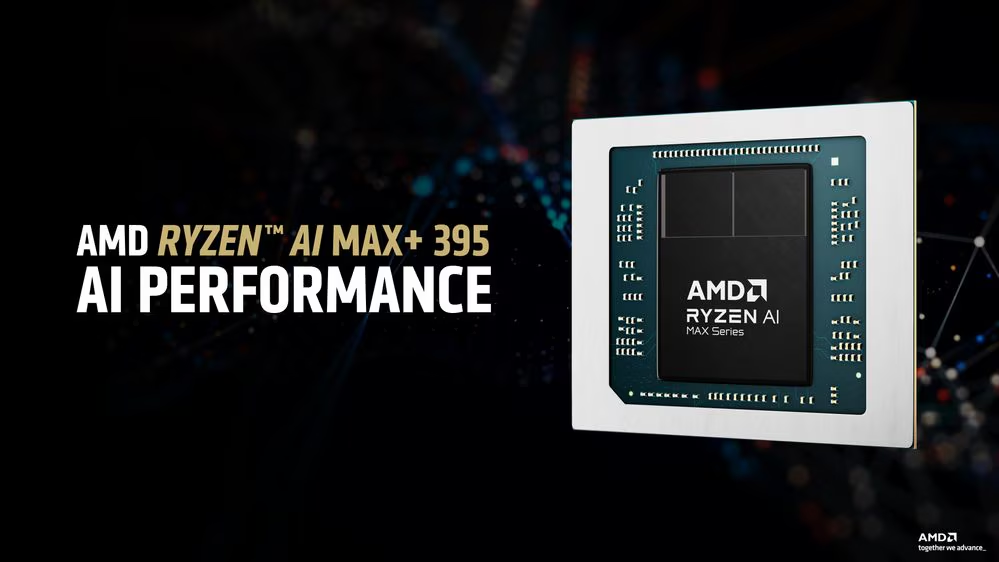
The AMD Ryzen AI Max+ 395 represents one of the biggest architectural changes in modern mobile computing. Built on AMD’s next-generation Strix Halo platform, the processor combines desktop-class CPU performance, powerful integrated graphics, dedicated AI acceleration, and unified memory into a single system-on-chip (SoC).
Rather than relying on a small, dedicated pool of VRAM, the Ryzen AI Max+ 395 utilizes an advanced 8-channel, 256-bit LPDDR5X-8000 unified memory architecture. This allows the CPU, GPU, and AI processor to access the same high-speed memory pool dynamically, improving efficiency across demanding workloads.
Key Specifications
- 16 Zen 5 CPU Cores and 32 Threads with boost clocks reaching up to 5.1GHz.
- 64MB Unified L3 Cache designed to reduce processing latency and improve overall responsiveness.
- Radeon 8060S Integrated Graphics featuring 40 RDNA 3.5 Compute Units that approach the performance of many discrete mid-range desktop GPUs.
- XDNA 2 Neural Processing Unit (NPU) capable of delivering more than 50 TOPS of dedicated AI acceleration.
The Strix Halo Architecture: Breaking the VRAM Barrier
One of the biggest innovations of the Strix Halo platform is its extremely wide 256-bit memory interface, which is twice as wide as the memory buses used in most modern laptops.
This enables the processor to achieve memory bandwidth exceeding 256GB/s, providing enough throughput for demanding AI inference, professional content creation, and advanced graphics workloads.
During intensive AI tasks, the processor can dynamically allocate as much as 96GB of unified system memory to function as graphics memory whenever necessary. This allows compact laptops to run local AI models that previously required expensive desktop workstations equipped with multiple dedicated graphics cards.
AI-Focused Unified Memory Is Becoming Mainstream
Unified memory is no longer reserved for ultra-premium workstations. AMD has expanded these technologies into portable AI-focused laptops powered by processors such as the Ryzen AI Max+ 392.
These systems intelligently distribute available memory between the CPU, GPU, and dedicated AI accelerator according to workload requirements. Instead of depending entirely on enormous VRAM capacities, modern processors are increasingly focused on maximizing efficiency through smarter resource allocation.
VRAM vs Unified Memory: Key Differences
| Feature | Traditional VRAM | Unified Memory |
|---|---|---|
| Memory Design | Dedicated memory physically attached to the GPU | Shared memory pool accessible by both CPU and GPU |
| Data Transfer | Requires constant copying between RAM and VRAM | Eliminates most unnecessary memory transfers |
| Bandwidth | Very high bandwidth optimized for graphics workloads | Balanced bandwidth shared across multiple processors |
| Latency | Extremely low for GPU-specific tasks | Optimized for overall system efficiency |
| Gaming Performance | Excellent for high-refresh-rate gaming and ray tracing | Efficient but not always optimized for peak gaming performance |
| AI Workloads | Strong for dedicated GPU computing | Excellent for memory-intensive AI models and shared datasets |
| Power Efficiency | Generally consumes more power | Typically offers better efficiency per watt |
| Scalability | Limited by installed VRAM capacity | Can scale to very large shared memory pools |
| Upgradability | Depends on GPU hardware | Usually integrated and non-upgradable |
| Best Use Cases | Gaming PCs, rendering, and enthusiast desktops | AI workstations, creators, and portable computing |
| Real-World Limitation | Large VRAM alone doesn’t guarantee higher performance | Shared bandwidth may become a bottleneck in some workloads |
| Industry Adoption | Common in traditional desktop graphics cards | Increasingly popular in AI-focused and hybrid computing platforms |
Why High VRAM Alone Is No Longer Enough
The graphics industry is gradually moving away from the long-held belief that larger VRAM capacities automatically produce more future-proof graphics cards.
Although large memory pools remain essential for specialized applications such as professional rendering, scientific simulations, AI training, and enterprise computing, they are no longer the primary factor that determines real-world GPU performance.
Modern graphics processors increasingly rely on several interconnected technologies working together, including:
- Advanced GPU architecture
- Memory bandwidth
- Efficient cache systems
- Dedicated AI acceleration hardware
- Software optimization
- Power management
- Thermal efficiency
As gaming engines, AI software, and professional applications continue to evolve, smarter memory management is becoming significantly more valuable than simply increasing dedicated VRAM capacity.
Bottom Line: The future of GPU performance is no longer determined solely by how much memory a graphics card has—it depends on how intelligently that memory is utilized by the entire system.
Thermal Efficiency Is Becoming a Major GPU Limitation
As GPU manufacturers continue pushing for higher performance, thermal efficiency has become just as important as VRAM capacity. Simply adding more memory chips, increasing core counts, and boosting clock speeds inevitably leads to higher power consumption and greater heat generation.
Modern flagship graphics cards can already consume well over 400 watts under sustained workloads. This creates significant challenges for cooling systems, airflow, power supplies, and long-term reliability.
Excessive heat also affects real-world performance. When temperatures exceed safe operating limits, GPUs reduce their clock speeds through thermal throttling, preventing the hardware from maintaining peak performance during extended gaming sessions, rendering projects, or AI workloads.
This is one of the reasons why modern GPU architectures are increasingly prioritizing intelligent performance scaling instead of brute-force hardware expansion.
Technologies such as unified memory, dedicated AI accelerators, larger cache systems, and improved workload scheduling help reduce unnecessary data movement while significantly improving performance per watt.
Apple has been one of the strongest advocates of this approach. By combining unified memory with tightly integrated silicon, the company delivers workstation-class performance while maintaining lower power consumption, quieter cooling systems, and improved thermal efficiency.
Why It Matters: For gaming laptops, compact desktops, portable AI workstations, and small-form-factor PCs, thermal efficiency may ultimately provide a greater long-term advantage than simply increasing VRAM capacity.
Future Console Memory Architectures Are Already Moving Beyond Traditional VRAM
Modern gaming consoles have quietly been demonstrating the future of memory architecture for years. Unlike traditional desktop PCs that separate system RAM from GPU VRAM, current-generation consoles rely on unified memory, allowing both the CPU and GPU to access the same shared memory pool.
PlayStation 5 and PS5 Pro
Sony’s consoles combine unified memory with technologies such as the Kraken hardware decompression engine and PlayStation Spectral Super Resolution (PSSR), an AI-powered upscaling system that improves image quality while reducing rendering workloads.
Xbox Series X
Microsoft employs its Velocity Architecture together with Sampler Feedback Streaming (SFS), enabling developers to load only the portions of textures and assets required at any given moment.
Why This Matters: These innovations allow consoles with only 16GB of shared memory to stream massive open-world environments efficiently without requiring enormous dedicated VRAM capacities.
Because memory resources can be dynamically allocated according to workload requirements, game engines no longer need to permanently reserve large amounts of dedicated graphics memory.
As future games become increasingly dependent on AI-assisted rendering, procedural world generation, real-time ray tracing, and intelligent asset streaming, flexible memory allocation will become more valuable than simply increasing VRAM capacity.
Upcoming console generations are expected to push this concept even further by combining:
- Faster unified memory
- Larger cache architectures
- Dedicated AI acceleration hardware
- Advanced compression technologies
- Direct storage streaming
- AI-assisted texture reconstruction
- Hardware-based asset decompression
These technologies dramatically reduce unnecessary memory transfers and improve overall efficiency, allowing developers to build larger, more detailed worlds without relying solely on increasingly massive VRAM pools.
As developers optimize future game engines around these shared-memory ecosystems, many of the same architectural ideas are expected to influence next-generation desktop GPUs.
Conclusion: The Future of GPUs Is Smarter, Not Just Bigger
For many years, larger VRAM capacities were viewed as the ultimate indicator of a graphics card’s longevity and future-proofing. While high-capacity VRAM remains essential for specialized workloads such as AI training, professional rendering, scientific simulations, and enterprise computing, the industry is clearly evolving beyond the simplistic belief that more VRAM automatically means better performance.
Today’s computing landscape is increasingly shaped by architectural efficiency, memory bandwidth, AI acceleration hardware, advanced caching technologies, thermal optimization, and intelligent software design.
Leading technology companies—including Apple, AMD, NVIDIA, Sony, and Microsoft—are investing heavily in smarter memory utilization rather than relying exclusively on larger dedicated memory pools.
Unified memory architectures, AI-assisted rendering, advanced compression engines, high-speed interconnects, and intelligent workload management are redefining how future GPUs and computing platforms are designed.
Instead of continuously increasing VRAM capacity, hardware manufacturers are building systems that:
- Move data more efficiently.
- Reduce latency.
- Improve performance per watt.
- Optimize memory allocation dynamically.
- Allow CPUs, GPUs, and AI processors to work together seamlessly.
For gamers, content creators, developers, and everyday users, future performance improvements are likely to come less from enormous VRAM numbers and more from intelligent system-level optimization.
The next generation of computing will not simply be defined by bigger graphics cards—but by smarter, more efficient hardware ecosystems working together as a unified platform.
Final Verdict: The future of GPUs is no longer about how much memory a graphics card contains. It is about how intelligently that memory is managed, shared, and utilized across the entire computing system.